The Work/Life Balancing Act: Will AI Set Creativity Free?
TL;DR: Will artificial intelligence liberate humanity from the burdens of everyday life to pursue more fulfilling and imaginative endeavors, or rob us of the very desire to be creative in the first place?
Poets and painters, writers and sculptors, et al, heck, even viral cross-stitchers with 150K IG followers, all bear the burden of balancing a desire to create juxtaposed against the inescapable responsibilities and inevitable mundanities of modern life. The successful ones manage this balancing act with effortless grace and aplomb (at least when viewed from the outside). Meanwhile, the struggle to reach an equilibrium leaves restless multitudes either abandoning their creativity altogether to focus on work or surrendering to their muse at the expense of everyday life.
Will the AI revolution free up those priceless hours, allowing humankind more time to expand our horizons, or will it rob us of the innate human desire to create in the first place?
You’ve come a long way, baby.
Let’s rewind to when early humans spent the daylight hours hunting and gathering, leaving zero free time to explore the creative spark pre-wired in their nascent, sentient minds. Hence the preponderance of cave painters hunkered down in the terrifying darkness, depicting the day’s events by the flickering firelight.
Next came agriculture and animal husbandry, an improvement, but perhaps more time-consuming than hunting and gathering. Who knows? Fast-forward to the printing press that opened new doors to human creative potential. Skipping ahead once again, centuries later, electricity, the light bulb, and the Industrial Revolution precipitated the present digital age where, at long last, the time required to stretch those creative muscles is there for the taking if we properly thread the proverbial needle and remember to pay the electric bill.
That’s the genius of modern life. And it is not to be taken for granted. We live in a privileged era that previous generations could only have dreamed of. And now that Wilma in Sioux Falls can rule over her self-made cross-stitching empire, would it make sense for her to relinquish her hard-won vocation to the faceless behemoth known as AI? What a travesty. Don’t do it, Wilma.
Utopia or Dystopia?
Despite the talking heads in love with the sound of their own voices, it’s beyond the ability of these so-called experts to predict with any degree of accuracy how the AI utopia, or dystopia, will impact those precious hours of creative output that we, as a sentient species, have struggled and sacrificed for millennia to achieve. That’s what makes AI so unsettling.
As an aside, I stumbled across a rather salient meme that resonated with a bluntness that cannot be denied. It depicted a static image of a weed growing from cracked and crumbled asphalt with the tagline: “I thought AI was supposed to figure out how to pull the weeds, so that I can paint. Not the other way around.”
That’s my fear. AI will pilfer the creative aspects of life right from under our damn feet, akin to the metaphorical “drink your milkshake” scene in There Will Be Blood. [1]
The Golden Ellipse
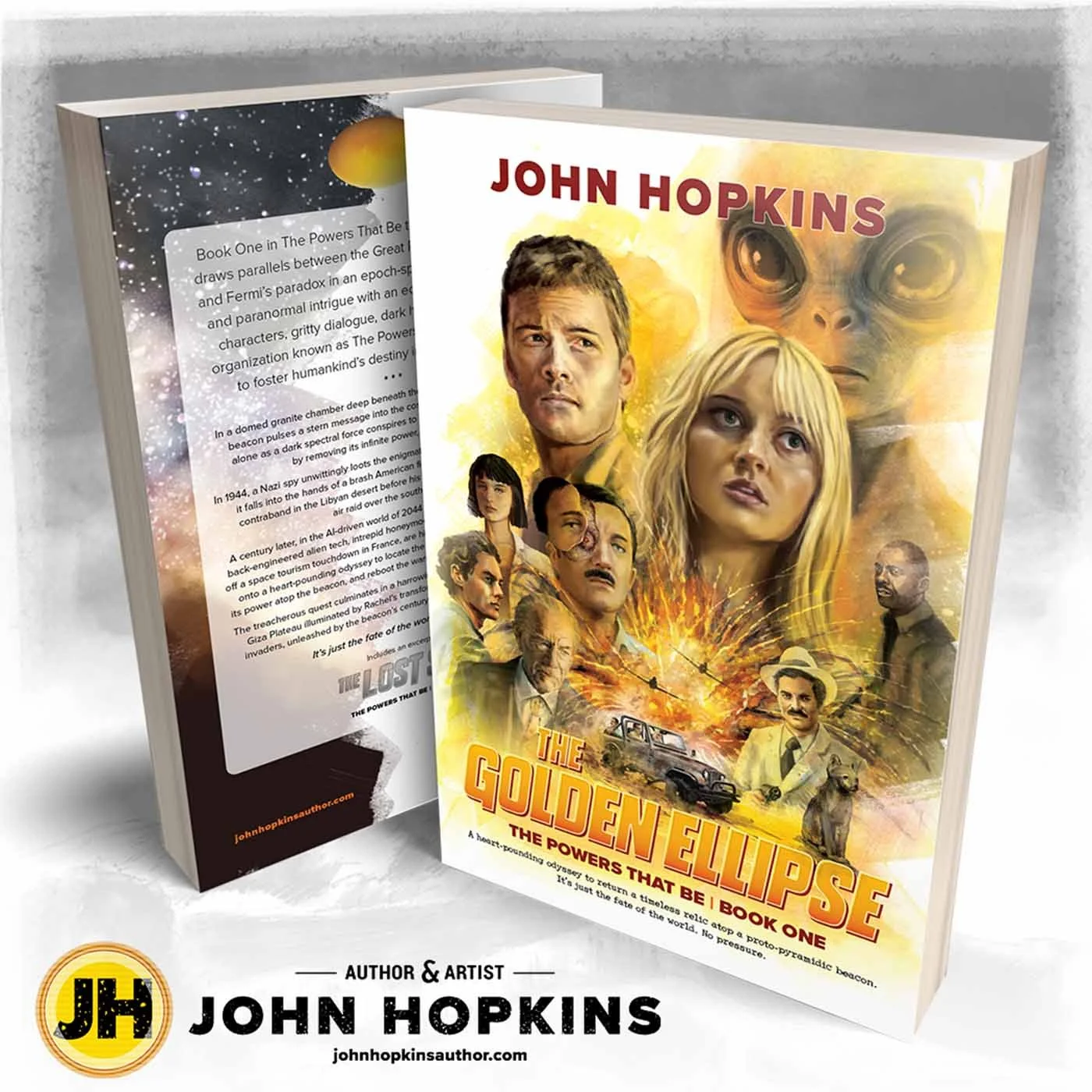
Since the milkshake reference segues into the fiction realm, let’s shift the focus onto my first science fiction novel from the perspective of artificial intelligence. Indeed, The Golden Ellipse introduces an all-too-plausible near-future world of 2044 replete with AI and human replicants. [2]
While the crux of the narrative across all three novels in The Powers That Be trilogy involves humankind’s ultimate place in a crowded universe, artificial intelligence is treated as the fact of life that it will no doubt have become, less than two decades from 2026. From the heartbreakingly poignant to the dangerously dire to the downright dystopian, AI plays an integral role (in a narrative sense) in a page-turning, ongoing saga that flows like blood through The Golden Ellipse and the novels that follow in its stellar wake.
Happy Reading,
JH
Postscript 1: Book Cover Redesign
Aside from the looming impact of AI, another conundrum for artists and creatives is exactly when to deem a project officially complete. As an author and artist, I confront the temptation to refine a formerly finished painting or edit a paragraph all of the time. It’s that striving for perfection which ultimately ends up, more often than not, slowing progress. Having said that, I have a short list of unfinished projects. And at the top of that list was the redesign of the cover for my first science fiction novel, The Golden Ellipse. Back in 2001, when it was first released, I was so keen to get it published that I rushed the cover’s Indiana Jones-esque movie poster vibe. While the original book cover was not terrible, I always knew in the back of my mind that one day I would take the time to realize my original vision. Long story short, through my own blood, sweat, and tears, I now have a new cover illustration in place (across all formats and distribution platforms) that comes within ten percent of my original goal. And while the process was rewarding, painting a single portrait is an unforgiving and painstaking process, even for seasoned professional artists. Now multiply that challenge by my homage to the inimitable Drew Struzan’s [3] knack for combining multiple likenesses into a single cohesive composition. I have learned a lot and now plan to redesign Books Two and Three to match this new/old cinematic throwback style. Stay tuned.
Postscript 2: Think of AI as a Tool, like a Hammer
When practicing your creative endeavors, whatever they may be, view AI as a tool (like a hammer). Whether it’s part of the software a writer uses to edit their work or a fast method of visual ideation for artists, AI is convenient, judgment-free, and here, whether we like it or not. Think of it as having Mr. Spock reading over your shoulder as you write. Having said that, the rendered art and written words must come from your own brain. Not a server farm from parts unknown scraping the digital universe and reassembling text and images on the screen like Frankenstein’s monster. What’s the damn point in that?
From a writer’s POV, I prefer replicant over android, robot, or humanoid. Android comes across as rather cold and indifferent. The word robot conjures visions of R2-D2, while humanoid brings to mind his partner, C-3PO. However, thanks to Blade Runner, a replicant can look like Sean Young. Need I say more?
