My creative journey from comic strip creator to sci-fi novelist.
TL;DR: In this post, I share a tongue-in-cheek reflection on my creative journey—from professional graphic designer to creating the Lost Cactus comic strip and how this lifelong aspiration surprisingly led to writing short stories and, finally, full-length science fiction novels.

Collection of early comic strips circa 1990 in pen and ink on vellum.
My creative journey.
My journey to authoring a science fiction trilogy with sequels in the works began a long time ago (not in a galaxy far, far away) at the pen-and-ink-blotched aspiration of creating the next Calvin and Hobbes. Before spit-taking your coffee and scoffing with righteous indignation, understand that I hail from a family of artists. Hence, the pie-in-the-sky notion of joining the hallowed ranks of Watterson and Schultz et al. was not far-fetched for a modestly talented art school student making his way in a world on the cusp of a new digital age (It’s hard to believe 1990 was 35 years ago).
Of course, the first dilemma when venturing down the path of developing a new comic strip involves avoiding the creation of yet another derivative strip about snarky pets and lovable loser owners. So, what to do? Fascinated by the idea of reanimating dinosaurs through DNA harvested from prehistoric amber at the center of Michael Crichton’s novel Jurassic Park, I sat at my father’s hand-me-down drafting table, sketching and inking a lab-grown dinosaur and mutant bee comic strip duo. What a novel concept. There was nothing like this in the funny papers as far as I knew. What could go wrong?
The reality of life, marriage, and a burgeoning commercial art career (at the absolute beginning of computer graphics) took center stage, relegating my hammy, gag-filled strips to a long-forgotten, dog-eared folder labeled Bentley, tucked away in a flat file under stacks of paintings and drawings, and soon forgotten.
Fast-forward a couple of decades to an older, not wiser, version of myself rediscovering this same dog-eared art folder unseen for years. While sifting through strips inked on old-school vellum, xeroxed sheets with scale percentages scribbled in the margins, and stacks of pencil-sketched character studies, the insane spark to resurrect my comic strip rekindled in my brain.
🤪 Or, I lost my mind. It depends on who you ask.
* * *
Moonlighting as a comic strip creator is not as easy as it sounds.
Following a year of juggling work and home life and squeezing in the drawing, writing, and development of the original strip’s unique backstory, Lost Cactus—the eponymous code name of a top-secret base sequestered in the arid southwestern hinterlands—came to life in 3-panel comic strips. With the aid of online resources and digital technologies nonexistent in my initial early-90s attempt at comic strip stardom, I now had an ongoing and viable strip with a set cast of characters. In addition to Bentley and Ty (the original bee and dinosaur duo), I created a white-coated scientist named Doc (my lovable loser) and a supporting cast of quasi-military characters, mutants, zombies, and aliens on the ultra-secret base. Envision M*A*S*H meets the X-Files, and you get the idea.
Cognizant of the remote chance of success, I snail-mailed submissions to syndicates far and wide. After too many rejection letters to count—and an interested editor’s suggestion to drop the alien character—I realized wedging my creation into the shrinking comics section of a vanishing newspaper industry was a non-starter. Only now, what to do with over 300 comic strips? Improvise. Leveraging my graphic design expertise and the fast-emerging self-publishing industry, I made two Lost Cactus anthologies. And because it’s never enough, I filled the colorful books with art, humorous essays, liner notes, pop quizzes, and something new and exciting for me at the time, science fiction short stories. These early forays into fiction writing, though a cringeworthy read in parts, foreshadowed characters, entities, and narratives that expanded outward like a big bang into The Powers That Be trilogy (The Golden Ellipse, The Lost Ship, and The Blue Spark).
What’s next?
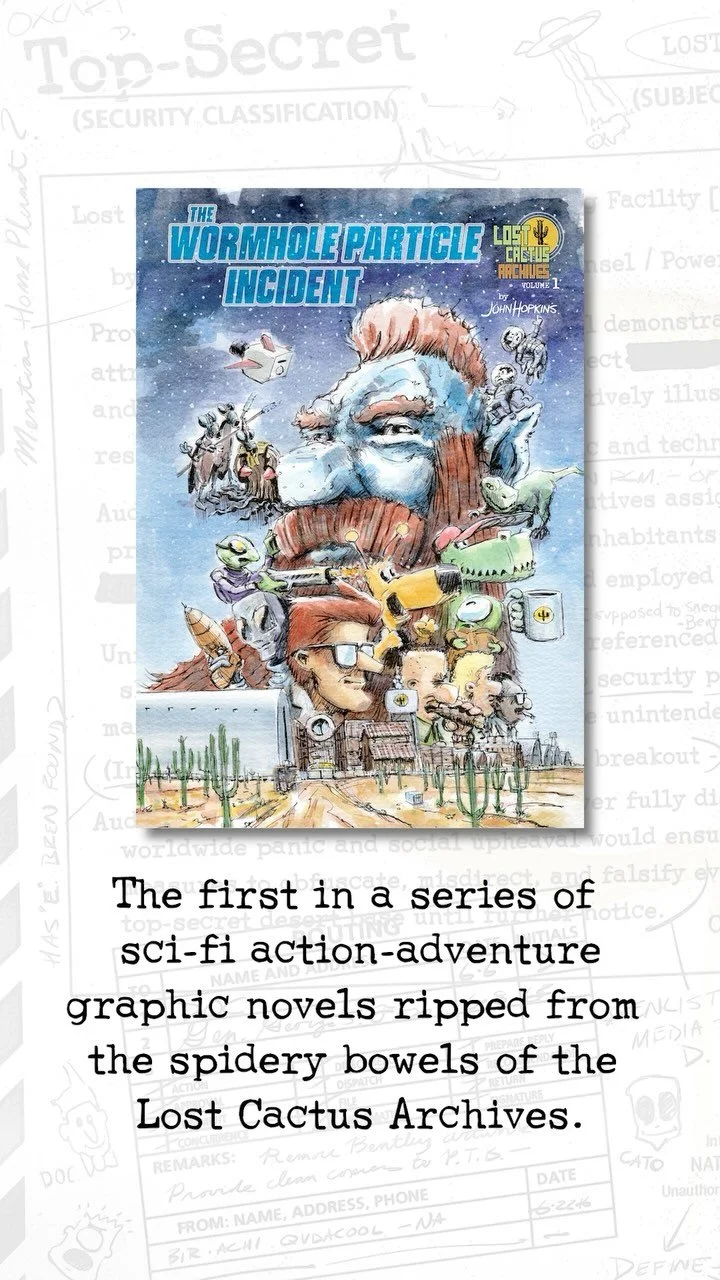
In the vein of other powerhouse world-building brands like Marvel and Star Wars, The Powers That Be | Lost Cactusmultiverse is an infinite canvas on which to write and paint new sci-fi adventures starring the expansive cast of old and new characters in everything from short stories and full-length novels to fully-illustrated graphic novels.
Check back often for news, updates, and teasers on upcoming projects in development as more ideas simmer on the back burners of my brain. Far from the typical writer’s block, I need more minutes, hours, and days added to weeks flying past like an out-of-control train speeding through the station. In other words, I need to clone replicants of myself like Professor Mitsuo Kobayashi, the robotics genius from The Blue Spark. (Perhaps with less fire, death, and dire consequences for humanity. 😬)
In other words, I have plenty more on the way, predicated on my mission statement of providing compellingly entertaining sci-fi action-adventure tales that expand like supernovas into uniquely imaginative visions of What’s Next.
Happy reading and keep an eye on the sky!
Author tip 1: Follow your muse—wherever it leads.
Could I have predicted my path from comic strip creator to science fiction novelist from the outset? Thereby avoiding the numerous inevitable pitfalls, dead ends, and failures. Short answer: No. Besides, where would the fun be in that?
The lesson? Life is messy and unpredictable by design, which makes it all the more worth living and writing about.
“You miss 100% of the shots you don’t take.” – Wayne Gretzky
“The best time to plant a tree is 20 years ago. The second best time is now.” – Chinese Proverb.
Author tip 2: Explore beyond common knowledge.
Researching the fascinating and, in parts, controversial subject matter underlying my science fiction has expanded my armchair understanding of a staggering range of uncommon knowledge—from ancient megalithic sites and uncontacted Amazonian cannibal tribes to the ingredients of a Corpse Reviver No. 1—as well as the ramifications and ethical debates over robotics, AI, and posthumanism to an eventual Omega Point as expressed in The Phenomenon of Man by Pierre Teilhard de Chardin. Along with the Jesuit priest’s somewhat controversial essay on humanity, a diversity of unconventional thinkers have influenced my narratives, from Fermi and Fibonacci to pop culture icons such as David Bowie and Indiana Jones.
Future blogs will offer fresh insights into my literary influences, starting with contemporary favorites, Michael Crichton, James Rollins, and Neal Stephenson, to science fiction pantheons, Isaac Asimov, Edgar Rice Burroughs, Ray Bradbury, and, of course, Jules Verne.
Author tip 3: Embrace your inner skeptic.
“Humankind’s place in the universe is an astonishing mystery to behold. Embrace your inner skeptic and dare to explore beyond common knowledge—that is where your answers lie, and the fun begins.” – John Hopkins
Receive epic savings on all books and art here on my site.
Become a Powers That Be insider.
Join the conversation and receive a Discount Code for an additional 15% off your first purchase—that’s in addition to the already discounted prices here on Squarespace (where I can cut out the middleman markup).
I also offer free shipping in the US and low flat rates of $15.00 for Canada and $18.00 for the rest of the world on all physical goods, from beautiful art prints to an expanding inventory of unique gifts. Check back often for the latest additions to the John Hopkins Art Gallery.
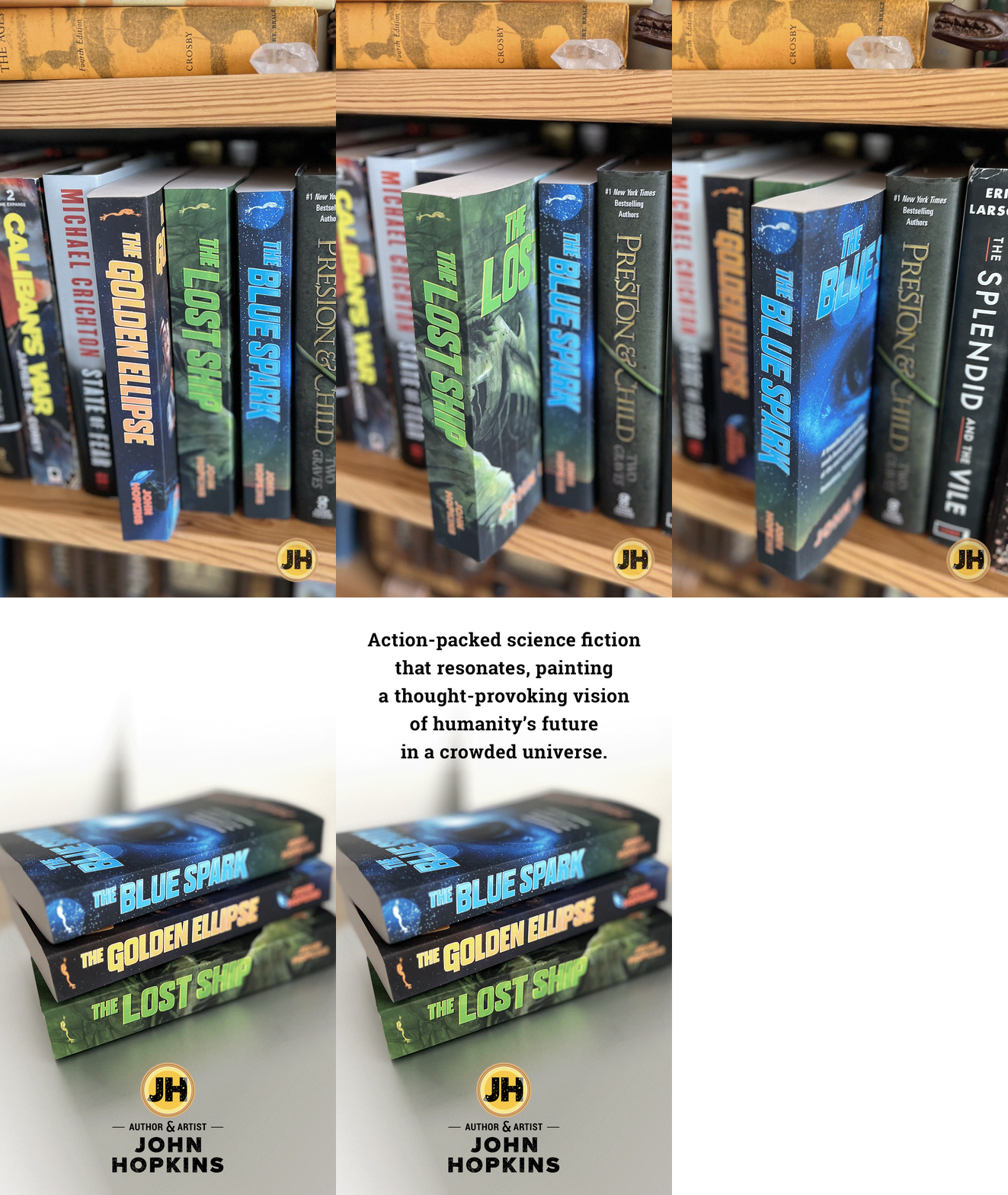
Big discounts on paperback and hardcover editions of The Powers That Be trilogy.
Each novel’s Shop page has additional links to secure checkout pages on Ingram Spark (my distributor). Physical editions of the eye-catchingly vibrant novels will enhance your bookshelf and make the perfect gift for avid readers, fans of the sci-fi genre, and anyone looking to lose themselves in a thrilling and thought-provoking new sci-fi read.